
Between California and Hawaii, in the middle of the Pacific Ocean, is a massive, swirling vortex twice the size of Texas. This ocean vortex is called a gyre, a natural phenomenon caused by global wind patterns. What’s not natural, however, is what swirls inside it: an estimated 100,000 tonnes of plastic.
This slow-churning whirlpool of plastic and other trash is known as the Great Pacific Garbage Patch (GPGP). And it’s growing. The circular motion of a gyre’s ocean currents means that once a piece of trash enters the system, it’s unlikely to escape. Over time, more and more garbage concentrates in the gyre’s center. Today, all the trash in the GPGP outweighs the plankton living there by six to one.
With more plastic than plankton in the water, surface-dwelling fish and marine animals risk becoming tangled in plastic film and netting. Many mistake trash for food, leading to illness and, eventually, starvation. But the GPGP’s harm doesn’t stop there. It impacts life on land, too, as those fish (and the microplastics inside them) end up in the human food chain.
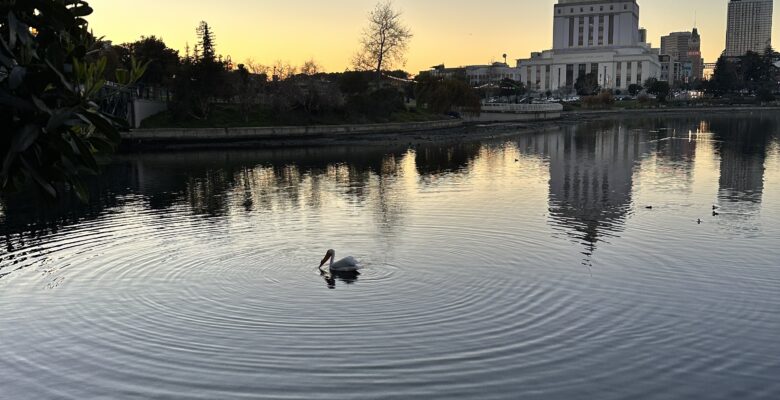
Imagine it: an ocean “soup” of trash stretching as far as the eye can see. Plastic lighters, toothbrushes, water bottles, pens, baby bottles, cell phones, plastic bags, unidentifiable microplastics, and larger floating items, too. That image should feel familiar: it’s the same type of trash Lake Merritt Institute volunteers remove from our cherished hometown lake every week.
All trash starts on land, from human communities just like ours. And it’s communities like ours — Oaklanders! — that are most effective at intercepting plastic and trash pollution before it reaches the ocean. Lake Merritt is part of the Oakland Estuary Watershed, which means it’s part of the planetary “circulatory system” that moves water from storm drains to creeks and rivers, into Lake Merritt, into the San Francisco Bay, and ultimately into the Pacific ocean. Our actions on land matter — because it’s all connected.
Every piece of trash pulled from Lake Merritt is one less item feeding the garbage gyre thousands of miles away. But even if you miss an occasional LMI volunteer day, you can still take care of your immediate environment: adopt a storm drain on your street, pick up debris from gutters, and dispose of trash properly. No matter where we are, when we stop plastic from getting into our watershed, we make the world a better place in a tangible way.
To learn more about the Great Pacific Garbage Patch, visit www.theoceancleanup.com.
By Kathleen Nay
Leave a Reply